Most people treat Sichuan as either "Chengdu and the pandas" or "the far west". This route is the join between the two, and it's the one I end up driving most often: out of the basin to the pandas, up under the four peaks of Siguniang, down into the watchtower valleys of Danba, then across the open grassland at Tagong. On the way home the country changes again — a hot-spring village, an expressway service area, a Zen temple, and finally the Leshan Buddha, an hour from Chengdu.
What I like about it as a first route is that nothing on it is abstract. The terrain, the architecture, the food and the altitude all change measurably from day to day, and you never have to move the car far between things worth seeing.
Names of guesthouses, restaurants and valleys are given in English with the Chinese in brackets — tap the bracket to copy it, so you can show it to a driver or a waiter.
The basics
- Route
- Chengdu → Wolong → Mt. Siguniang → Danba (Zhonglu) → Tagong → Yingjing → Leshan → Chengdu
- Days
- 5 days, 4 nights
- When we drove it
- 30 September – 4 October 2026
- Best season
- May–June, and October through December
- Best light
- Early at the monasteries; the last hour on the grassland
- Pace
- One long drive at each end, three short hops in between
- Where you sleep
- A Tibetan village under the peaks · a courtyard facing a sacred mountain · the grassland · a Zen retreat beside an old temple
- Driving
- Your own car, or a chartered car and driver
The route, leg by leg
- ChengduStart · Day 1 180 km · 3.5–4 h
- Mt. Siguniang townNight 1~3,200 m 110 km · 2.5–3 h
- Zhonglu, DanbaNight 2 110 km · 3.5 h
- TagongNight 3~3,700 m 250 km · 5–5.5 h
- Yingjing, near Ya'anNight 4 140 km · 2 h
- LeshanDay 5 140 km · 1.5–2 h
- ChengduFinish · Day 5
Approximate driving distance and time from one stop to the next (read top to bottom), not counting time spent at them.
Quick answer: the order of the nights is the whole trick. You climb to about 3,200 m on the first night, drop lower into Danba on the second, and only then go up onto the grassland at around 3,700 m — so the altitude comes to you instead of hitting you. Put the two long drives at the two ends of the trip, and don't add anything to the middle.
At a glance
| Day | Where you sleep | The point of the day |
|---|---|---|
| 1 | Siguniang town (~3,200 m) | Pandas at Shenshuping, lunch at Duomucha in Gengda, the climb over the pass, the four peaks from Mao Bi Liang |
| 2 | Zhonglu, Danba | One valley — shuttle bus or on foot — then down to the watchtower village |
| 3 | Tagong (~3,700 m) | Over a 4,200 m pass to the grassland: two monasteries and the mani stones |
| 4 | Yingjing, near Ya'an | Off the plateau: a hot-spring village, a strange yoghurt, a Zen temple for the night |
| 5 | Chengdu | Leshan Buddha — then home by dinner |
Day 1 — Chengdu to Mt. Siguniang: pandas, then the climb
Leave Chengdu at about 8:00. The first day is the transition day: you trade the grey basin for a valley that folds up between two walls of mountain, and the country gets higher, drier and quieter as you go.
The pandas at Shenshuping
Up the river valley from Yingxiu, the panda base at Shenshuping is the stop most people build the morning around. Leave at 8:00 and the earliest you can be there is about 10:00; the ticket is ¥150 per person. The animals are in large forested enclosures rather than concrete pens, and it's the first real change of scenery on the trip.
Photo note: pandas don't perform. Shoot the ones that are awake, then move on — you still have a pass to climb.
Lunch: Duomucha, in Gengda
Gengda, the small township the panda base sits in, is where I stop to eat — at Duomucha , a Sichuan-Tibetan kitchen where the pot is already going when you walk in. Order the yak hotpot , and if you want to eat the way people here do, add hand-torn yak meat — torn off the bone and eaten with your hands. The thing I wouldn't skip, though, is the barley yak yoghurt : of everything on the table, it's what I order every single time.
Mao Bi Liang
Further up, Mao Bi Liang is the classic viewpoint for the four peaks of Siguniang — the "four girls" in a row, with the highest of them, Yaomei Feng, standing behind the others. On the way up you'll almost certainly be in cloud; the question is whether it lifts.
Photo note: this is a weather window, not a scheduled stop. If the peaks are out when you arrive, take the picture then — in twenty minutes they may be gone.
Where you sleep: Siguniang town, ~3,200 m
Stay in the village that climbs the hillside above the Shuangqiao valley entrance — the whole settlement has been turned into guesthouses, so you're sleeping inside the place rather than beside it. I stay in a Tibetan-run house, Jiarong Qingcheng , partway up the hill.
What makes it more than a bed: every evening the village puts on a performance — local Tibetan kids singing in Tibetan — and it ends with everyone, guests included, being invited down onto the square in front of the stage for a bonfire and circle dancing (guozhuang ), the performers leading from the inner ring. Dinner is easiest at the guesthouse restaurant. Breakfast runs 7:30–9:30 and is a simple Chinese one — milk, soy milk, steamed buns, eggs, congee, sausage, pickles.
This is your first night at altitude, and the start of a climb that takes three days to finish.
Day 2 — one valley, then down to Danba
Leave at about 8:30. Today is about one valley, done properly, and then a move into a completely different landscape.
Choose your valley
Siguniang gives you a choice between two, and the right answer depends on the weather:
- Shuangqiao — the more travelled of the two. A shuttle bus carries visitors up the valley and stops at set points, and every stop is a different composition: forest, meadow, snow peaks at the head of the valley. If the weather is fine and you want the scenery with the least effort, this is it.
- Changping — mainly a walking route up the same kind of valley. The scenery is similar, but there are far fewer people and it feels wilder and more untouched. Choose this if you'd rather earn it on foot.
Lunch usually happens inside the day: local people set up stalls along the way and sell boiled corn, sausages and the like.
Whichever you pick, you're usually finished by about 3 pm, and then you drive to Zhonglu in Danba. If there's time on the way, Wolori Tusi village is worth a short stop — you can get close to the Tusi's old watchtower (diaolou ) and see the defensive architecture at first hand.
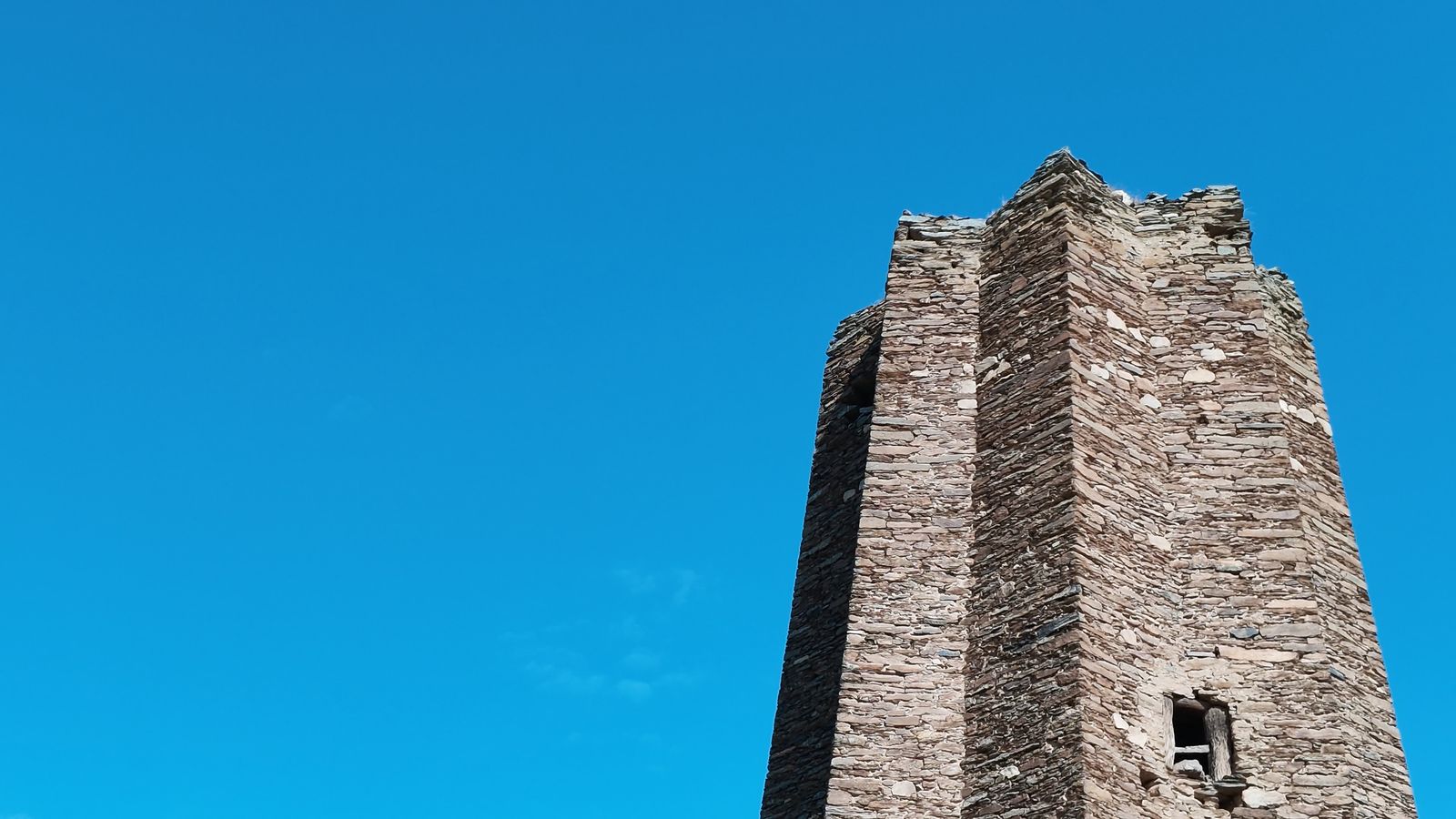
Where you sleep: Han'e Manor, Zhonglu
This is the one I wouldn't swap. Han'e Manor is the birthplace of Han'e culture, and the building is effectively a small museum. It faces the sacred mountain Murdo , which makes the view the best part of the stay. The construction follows the original Tibetan timber method and has real character, and the owner is unfailingly courteous.
If you get there early enough, ask the owner about the Tibetan culture sessions — you can mould a tsa-tsa , the small clay Buddha figures cast in a mould, or make Tibetan incense . Dinner at the manor is the obvious choice; there's no reason to go looking.
Photo note: the watchtower villages want early or late light; at midday they flatten into the hillside. You're lower here than last night — Danba's valleys are a good place to sleep deep.
Day 3 — Zhonglu to Tagong: the pass, the grassland, two monasteries
Leave at about 9:00. This is the day the trip changes character. From Zhonglu you run through Danba town, then up past the Yala Snow Mountain viewpoint , over the Geda Liangzi pass at about 4,200 m, through Bamei, and down onto Tagong.
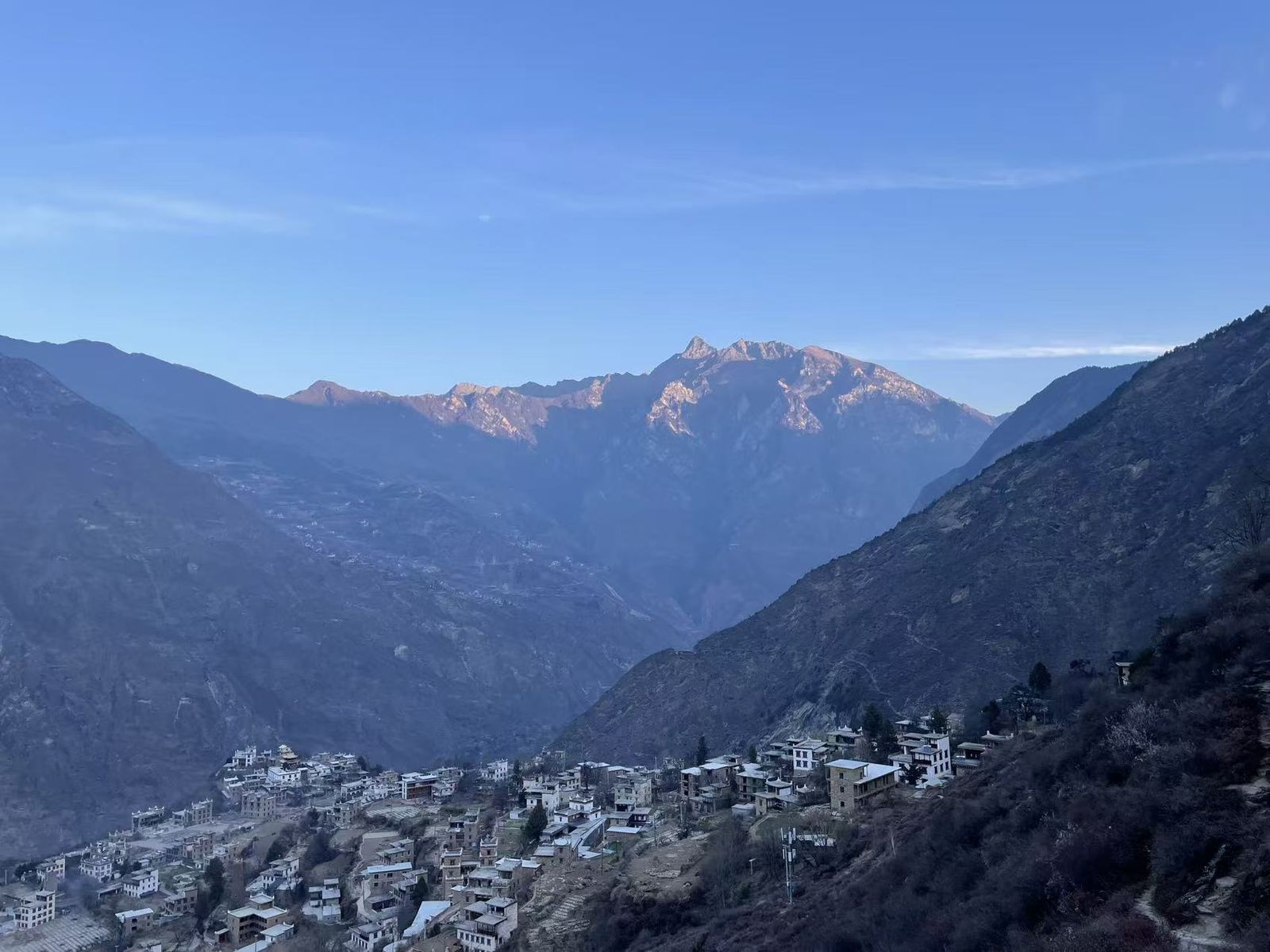
Somewhere on this stretch the terrain reorganises itself in front of you: gullies and forest give way to plains and grass. That's the moment the route is for. If you're lucky, Yala shows — the sacred peak that anchors the whole area.
Tagong Monastery
Arrive around 12:00 and park in the lot in front of Tagong Monastery — there's usually a space. Lunch first, at the Nepali restaurant next door: Nepali, Indian and international cooking, and an owner who really knows how to use spices. They've made the place comfortable too, and you can rest in their sun room after eating.
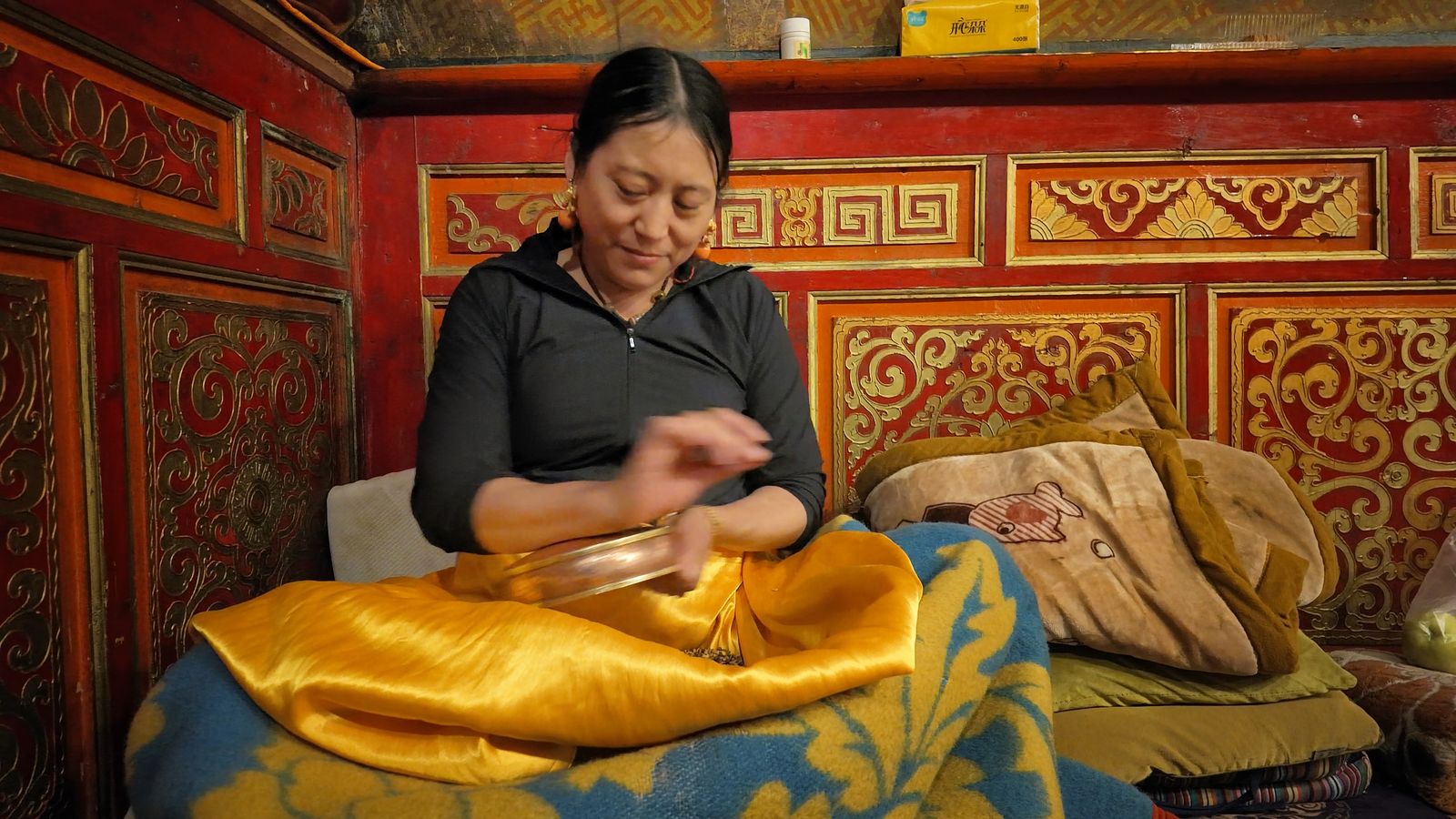
Then, at about 2 pm, the monastery itself.
- It's a 1,300-year-old Sakya monastery, and the main object of veneration is a Shakyamuni statue at the age of eight. It also houses Thousand-Hand Guanyin, Padmasambhava, Songtsen Gampo, Princess Wencheng, Gar Tongtsen, the five Sakya patriarchs and Green Tara.
- The story behind it — and this is the local account, not a history lesson: when Princess Wencheng was passing this way with the Shakyamuni statue she had brought from Chang'an, it would not move any further. The Buddha, it's said, liked the place. So the monastery grew where the statue stopped.
- In the hall at the very centre, the golden mandala. It's the one object the local account keeps returning to. The story is that this whole plain was once a lake; the mandala was carried here and enshrined, the water gave way, and what was left is the ground Tagong town stands on. (A mandala here means the three-dimensional palace, not the offering.)
- Ten years ago, a small stone vajra is said to have appeared on the ground of the monastery square, out of nowhere. It's still there, now wrapped in layers of glass to protect it.
- Etiquette, and this matters: the hall with the eight-year-old Buddha is the only one where you take off your shoes, and the only one where photography is not allowed. Every other hall allows shoes, but don't photograph the statues — locals can take it as a sacrilege. You'll sometimes see Tibetans doing full prostrations outside the main hall, or making mandala offerings. Ask before you photograph them.
Entry has lately been free; when it was charged, it was ¥20 per person.
Muya Monastery
About 15 minutes' drive, from the monastery at about 3:30 pm. On the way you'll see it sitting at the foot of Yala. Park outside the gate; entry has usually been ¥16 per person. Inside, on the left, two monkeys are kept tied up, and there are deer and sheep in the grounds that can be aggressive — there have been reports of them injuring visitors, so keep your distance.
Muya is a Nyingma monastery, and since the Nyingma tradition was founded by Padmasambhava about 1,300 years ago, his statue is the principal one. What stays with me is the scale: it works like a campus. The central hall is the grand classroom; the buildings either side are dormitories and a dining hall.
Jiagulong mani stones
Five minutes further on, Jiagulong is a mani stone heap ringed by enormous prayer wheels, with local people walking clockwise around it — clockwise, never anticlockwise, which is taken as an omen of bad luck. Then follow the same small road back into Tagong town.
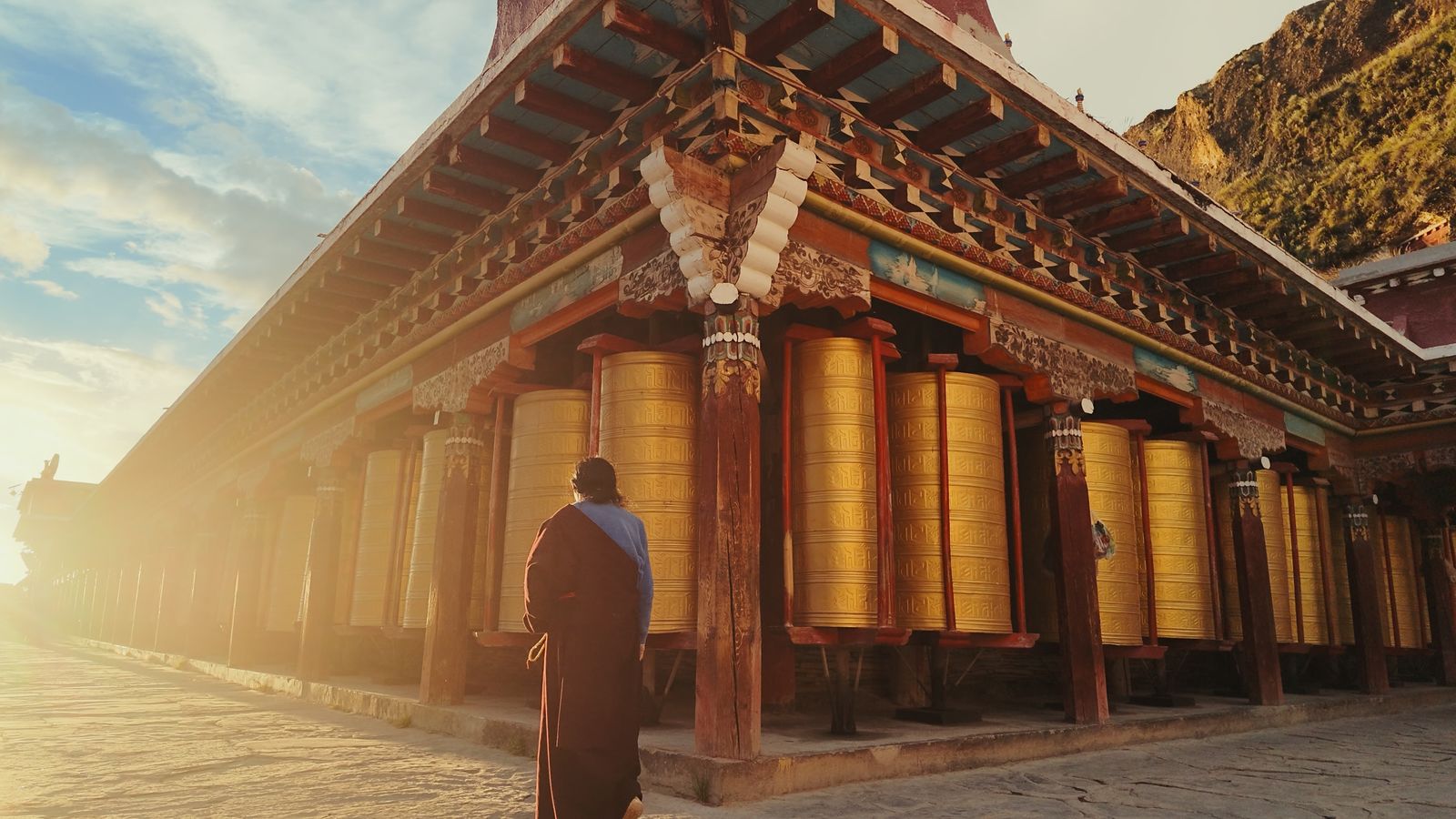
Dinner is a Sichuan restaurant in town; they're all decent.
Where you sleep: Dejieling Manor
Dejieling Manor is run by a very welcoming Tibetan owner with three sons, two of whom are monks at Tagong Monastery. They take foreign guests. Breakfast runs 7:30–9:00 and is a proper Tibetan breakfast: yak yoghurt, butter tea, local apples, pickles, barley cakes , buns filled with mashed potato, and eggs.
This is the high night — around 3,700 m. See the notes below.
Day 4 — Tagong to Yingjing: the long drive off the plateau
Before you leave, if you have the appetite, go out and walk the kora around Tagong Monastery — clockwise, with everyone else, reciting as you go. This is a place of genuinely undiluted faith, and the mornings are when local people complete their practice. It's the least "sight" of the whole trip and often the one people remember.
Departure is flexible. Lunch is either in Tagong or in Kangding — and if you're choosing, choose Kangding: Zangjiayan is the most authentic Tibetan food I know on this road. The owner was previously head chef at a five-star Tibetan culture hotel, the cooking is excellent, and locals eat there too. The location is a bit hard to find — it's in a residential building.
Then the long drive down. Two stops on the way:
- Zhonggu village , a hot-spring village. The one to go to is Yagulinka , a hot-spring resort, and foreign guests are welcome. A good soak before the next stretch of road.
- Tianquan service area on the expressway, for a box of the local "caviar yoghurt" . It costs ¥44 a box and the taste is genuinely strange — and genuinely good.
Dinner in Yingjing. Yingqing Restaurant does Sichuan food with some real heat — and the thing to order is Yingjing bangbang chicken , whose bowl of red oil looks terrifying and isn't spicy at all.
Where you sleep: Yuansuo, beside Yunfeng Temple
Yuansuo is a hotel with a real sense of Zen. Around 8 pm it runs a session of guided meditation or sound healing; at 10 am there's a morning class, chanting together; breakfast is Chinese, a few healthy steamed and boiled dishes — spinach, yam, corn — with eggs and a bowl of rice noodles or noodles made that day. At 10:30 there's a talk about Yunfeng Temple .
The temple is worth the stop on its own: two of its zhennan trees are 1,300 years old, and — rarer still — it's a temple with essentially no donation boxes, where you seldom even see monks. Arrive at the right hour and you get a moment of real quiet; the garden genuinely embodies Chinese feng shui thinking.
Day 5 — Yingjing to Chengdu: Leshan Buddha on the way home
Leave at about 9:00 for Leshan.
Lunch first: bobo chicken
Grandma Ye's does the Leshan version of bobo chicken — and the way it works is half the fun. Find a seat, then walk over to the fridge full of skewers, give the staff your table number, and pick your skewers — plenty of offal, plenty of vegetables, take whatever looks good — hand the plate to the staff, then go back to the table and scan the QR code to order the rest. I'd add their fried rice to the order.
The Leshan Giant Buddha
You've got two ways to see it: climb the cliff path down beside the statue, or take the boat and see it whole from the river. Tickets are normally bought in advance on the WeChat mini-program "Leshan Tourism" ; around Chinese public holidays you may need to book several days ahead. If you can't get one, there are usually same-day VIP tickets at roughly 210% of the standard fare, which include a shuttle bus, less walking, and an entrance of their own.
You'll usually be done around 5 pm, and that puts you back in Chengdu just in time for dinner.
Things people get wrong here
Four that catch people out
Altitude. On this route the numbers are: Siguniang ~3,200 m on night one, Danba lower on night two, Tagong ~3,700 m on night three, then down off the plateau. The order is deliberate — it lets you climb gradually instead of arriving straight at the highest point from Chengdu. Drink more water than you think you need, keep the first evening quiet, and treat the Geda Liangzi pass at 4,200 m as a drive-through, not a place to linger and walk hard.
The monasteries are working places. In Tagong Monastery only one hall asks for shoes off and forbids cameras — but in every hall the statues are not for photographing, and people kneeling outside are not props. Ask first; it costs nothing.
Walk the right way round. The prayer wheels and the mani stones are walked clockwise. Going the other way is not a small mistake to the people watching you.
Don't pet the animals at Muya. There are deer and sheep in the grounds with a record of injuring visitors, and two monkeys tied up by the entrance. Keep your distance and keep your hands to yourself.
How to give the day to the right light
The mistake is spending the middle of the day on the things that are only good at the edges of it.
- First light — the monasteries and the prayer-wheel paths, while the town is waking up and the sun is still low. This is also the hour for the kora at Tagong.
- Mid-morning to midday — driving, viewpoints and the long transfers; save the walking for the cooler hours.
- Afternoon — the second valley, the mani stones, the tower villages. Flat light, so give it to places that don't need shape.
- Last hour of light — grassland, animals, the wide horizon, the village above the valley. This is the hour the whole trip is built around.
- After dark — Siguniang's bonfire and circle dancing; and at altitude, step outside and look up.
If you're coming to shoot
Bring whatever you normally shoot with — phone included. The difference here isn't the camera, it's being in the right place at the right hour, and that's mostly a matter of planning the day around the light rather than around a list of sights.
- Wide for grassland, long for peaks. The mountains are far away; the grassland is right in front of you. Both need different glass.
- Spare batteries live in an inside pocket. Cold empties them fast at this altitude.
- A tripod earns its weight for the pre-dawn light, the after-sunset light, and clean long exposures of the grassland.
- Ask before photographing people. Always — and especially outside the monastery halls and at the mani stones.
- Inside the halls, no statues. That one isn't negotiable.
If you only have four days
Drop the last day, not the middle. The loop still works without Leshan: give Siguniang its valley and its village night, keep the whole Tagong day intact, and come back the direct way. You lose the Zen temple and the Buddha; you keep the part most people actually came for.
Questions I get asked before this trip
How many days do you need for this loop?
Five days and four nights is comfortable. Four works if you drop the last day.
What's the best time of year?
May–June, and October through December. Those two windows are the ones I'd pick.
Do I need to book anything in advance?
For the Leshan Buddha, yes — tickets are normally bought in advance on the WeChat mini-program "Leshan Tourism", and around Chinese public holidays you may need several days' notice. The monasteries are paid at the gate, and Tagong Monastery has lately not been charging at all.
Can I do it without a car?
Not comfortably, and not quickly. This part of Sichuan is remote, and in some places there's only one public bus a day — so stringing buses together costs you most of the trip in waiting. The practical answer is a chartered car and driver for the whole loop.
Is it hard to drive?
The road is the easy part. What catches people out is the altitude and the pace — so drive shorter days than you think you should, and stop more often than you planned to.
Is it OK to take photos inside the monasteries?
In Tagong Monastery, only one hall forbids it outright. Elsewhere, keep the camera off the statues, and always ask before photographing people — especially anyone praying or prostrating.
What should I wear?
This is high plateau at the start and a warm basin at the end. Layers, sun protection and something windproof will cover the whole five days better than one heavy jacket.
Honest notes
Everything in this guide comes from roads I drive myself — not from other people's lists. Conditions change: a gate closes, a valley gets rebuilt, a ticket rule changes, a viewpoint gets a new fence. If you get there and something is different, tell me and I'll correct this page.
Where I've named a guesthouse or a restaurant, it's somewhere I stay or eat — not a paid listing, and not a ranking. There are dozens more like them. Prices, where I've given them, are the entry fees and counter prices charged on the day, and they move.
If you're planning around this loop and want to know what the light is doing in your month, that's a question worth asking before you commit to dates — write to me.